Written by Mary McKinnon, PTA
Swimming places repeated demands on the shoulders, particularly during the pulling phase of each stroke. When the muscles that stabilize the shoulder blade and shoulder joint are weak or poorly coordinated, swimmers may compensate with inefficient mechanics that can contribute to shoulder pain.
Improving shoulder strength and stability can support better movement mechanics, reduce strain, and help swimmers perform more efficiently in the water. The exercises below target key muscles involved in scapular control and rotator cuff stability.
Scapular Stability
As the arm moves, the shoulder blade move along the thoracic spine. Three muscles—the upper trapezius, lower trapezius, and serratus anterior—work together to move the shoulder blade in a controlled manner.
Lower Trapezius
The upper trapezius often becomes tight and compensates for weakness in the lower trapezius and serratus anterior. To improve stability and movement mechanics, try the exercises below.
The lower trapezius stabilizes the angle of the shoulder blade relative to the spine.
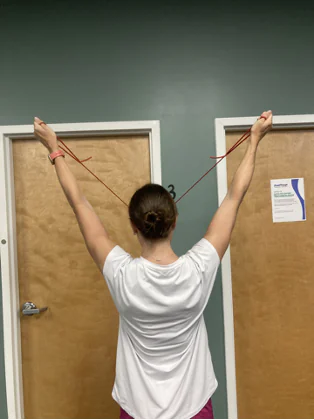
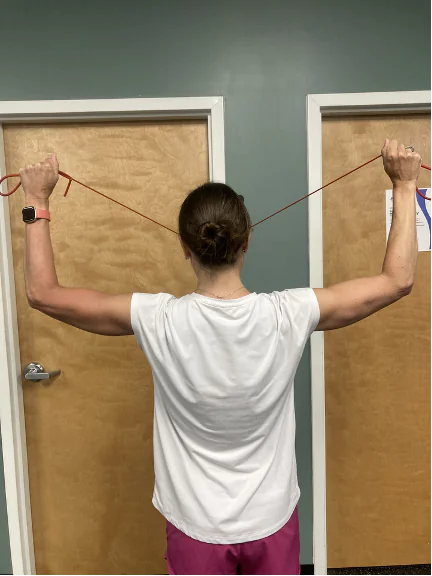
Banded Y’s
- Attach a resistance band to the top of a door frame.
- Position your arms in a Y shape.
- Glide your shoulders back and down.
- Resist the band as it returns your arms to the starting position.
Serratus anterior
The serratus anterior helps stabilize the shoulder blade against the rib cage and supports controlled movement of the shoulder blade during swimming. Strengthening this muscle can help improve shoulder stability and mechanics.
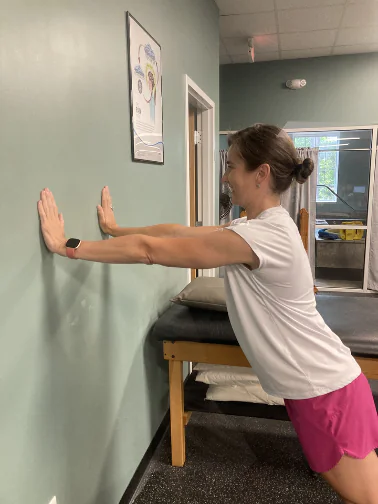
Push-Ups with a Plus
- Start in a wall plank position with your hands on the wall at shoulder height and your feet approximately three feet from the wall.
- Stabilize your lower back by gently drawing your belly button toward your spine.
- Press your sternum and upper back away from the wall while keeping your neck long. This movement should gently round your upper back.
- Relax the muscles along the sides of your rib cage, allowing your shoulder blades to return toward your spine and your sternum to return to the starting position.
Rotator Cuff Stability
Several muscles also help stabilize the upper arm within the shoulder joint. The subscapularis, supraspinatus, infraspinatus, and teres minor work together to form the rotator cuff. The rotator cuff helps stabilize the upper arm within the joint during shoulder movement. Try the exercises below to strengthen the rotator cuff.

Banded Internal Rotation
- Attach a resistance band at elbow height.
- Stand with the band beside you and hold it with the arm closest to the attachment point.
- Keep your elbow at your side.
- Rotate your hand toward your lower ribs.
- Slowly resist the band as you return to the starting position.
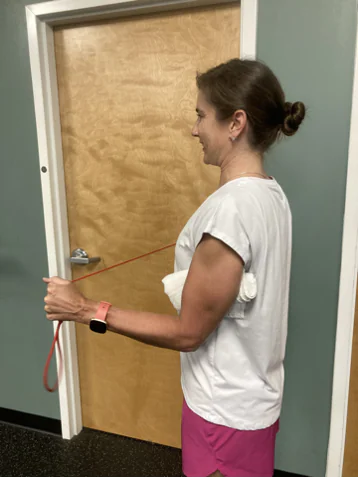
Banded External Rotation
- Turn so the opposite side of your body faces the attachment point.
- Hold the resistance band with your elbow at your side.
- Begin with your hand near your stomach.
- Rotate your hand away from your stomach and toward the wall.
- Slowly resist the band as you return to the starting position.
Banded 90-90 External Rotation
- Attach the resistance band at shoulder height.
- Face the door or attachment point.
- Lift your arm to shoulder height and bend your elbow to 90 degrees.
- Rotate your forearm until your hand moves toward the ceiling.
- Slowly resist the band as you return to the starting position.

Banded 90-90 Internal Rotation
- Turn in the opposite direction so your back faces the attachment point.
- Begin with your elbow at shoulder height and your hand above your elbow.
- Rotate your upper arm to bring your hand forward and down to shoulder height.
- Slowly resist the band as you return to the starting position.
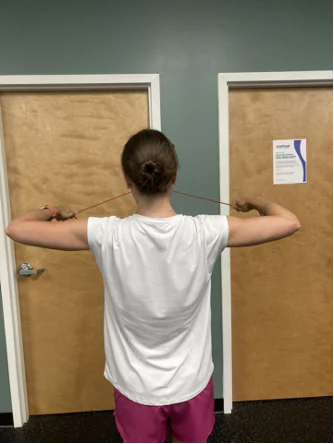
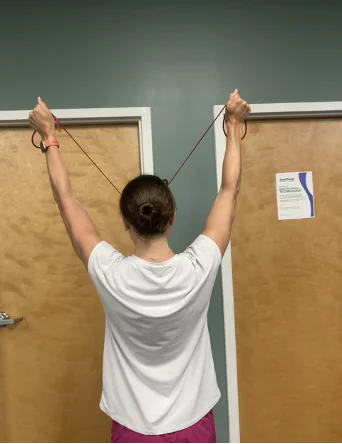
Banded Row with External Rotation and Overhead Press
To retrain the scapular stabilizers during overhead reaching, try an exercise that combines scapular stabilization, rotator cuff strengthening, and general shoulder strengthening.
- Begin with your arms at shoulder height.
- Glide your shoulder blades back and down.
- Move your elbows backward until they are even with your shoulders.
- Rotate your upper arms to bring your hands toward the ceiling.
- Maintain stability through your shoulder blades as you press your arms overhead.
- Slowly reverse the movement and return to the starting position.
Final Thoughts
These exercises can help improve shoulder strength, stability, and control, which can support more efficient swimming performance. If you experience shoulder pain while swimming or need a comprehensive plan to strengthen your shoulders, visit one of our Physical Therapists for an individualized evaluation and treatment plan.